

Allie
 Case Background
Name: Allie
Age: 13-years-old
Sex: Female, spayed
Breed: Miniature Schnauzer
Age: 13-years-old
Sex: Female, spayed
Breed: Miniature Schnauzer
 Clinical History
Please review Allie’s clinical history.
Allie has been slowing down over the last 3 months. This morning, she had a collapse event where she was on a walk and suddenly stopped, fell over, and started paddling. The client picked her up and rushed her to an emergency clinic. By the time she arrived, Allie walked in to the clinic and appeared fine. The emergency clinic noted an irregular heart rhythm.
 ECG
ECG
 Discussion & Treatment
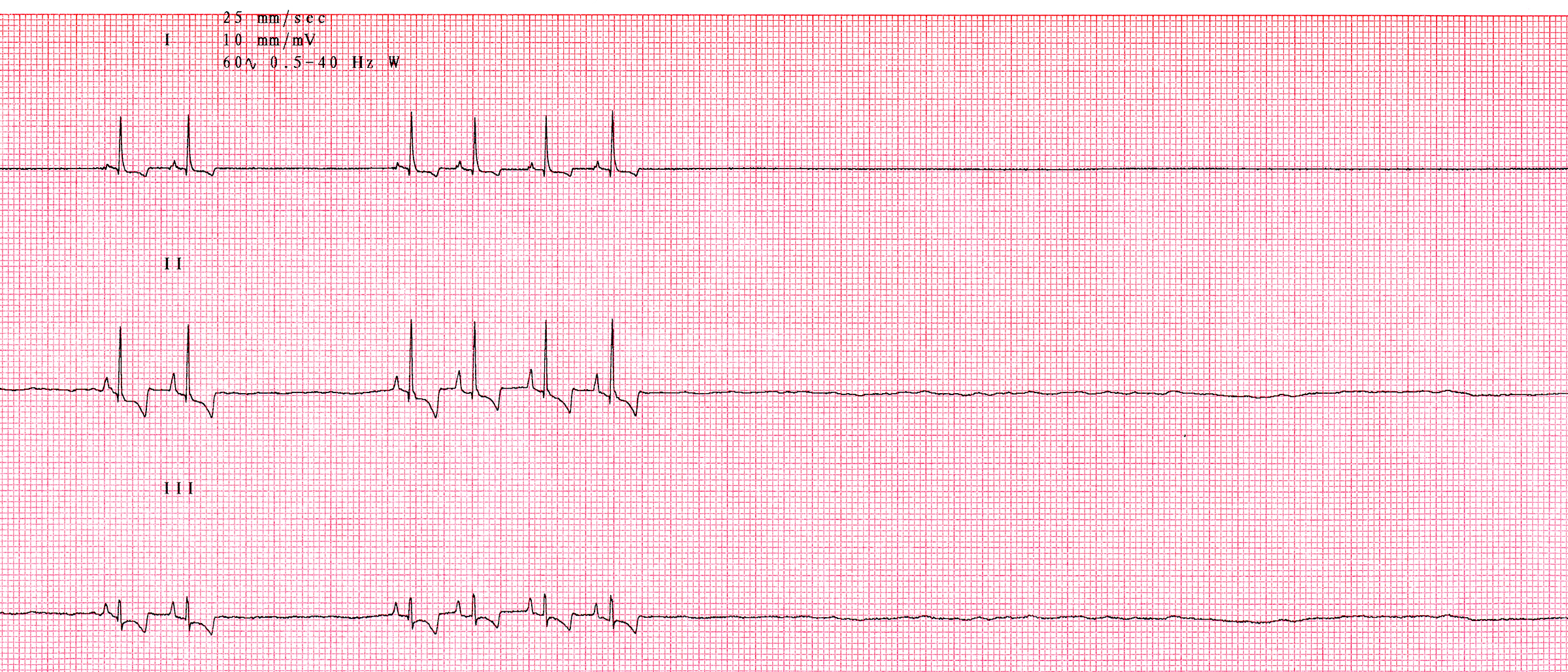
Discussion: Sinus node dysfunction is suggested on the ECG by the frequent and prolonged sinus pauses/arrest. In a dog of this breed, the most likely underlying condition to explain the collapse event is sick sinus syndrome – a disease characterized by age-related degeneration and fibrosis of the sinus node with clinical signs of collapse/syncope. Notably, there is a lack of any escape beats from the distal conduction system (AV node, Purkinje fibers) to rescue the rhythm. The lack of any escape complexes suggests that the entirety of the conduction system is affected. Treatment/management: Sinus node dysfunction is a rhythm diagnosis, while sick sinus syndrome is associated with clinical signs. Sick sinus syndrome occurs primarily in three breeds – the Miniature Schnauzer, the West Highland White Terrier, and the Cocker Spaniel. Management of clinical signs is accomplished by stabilization of the underlying rhythm. In most patients, this requires implantation of an artificial cardiac pacemaker. Positive chronotropic drugs (theophylline, terbutaline, hyoscyamine) can be tried, but tend to have limited success. If a pacemaker is not pursued, clinical signs of collapse and weakness tend to progress and impair quality of life. With pacing, the prognosis is good to excellent.